



– By Gary Auman Legal Counsel for NFBA –
With the arrival of the summer construction season come warmer temperatures and the risk of heat-related illnesses. Workers daily face many hazards on the job site, and heat stress is one of those hazards (see the Safety Update in the June 2013 issue of Frame Building News). Heat stress poses several threats. The main danger is the potential of death for the person suffering from heat stroke. A second danger is the one that the person suffering from heat-related illness poses to fellow workers if he or she is suffering from the delirium that heat-related illness can cause. Fortunately, these dangers can be addressed and minimized with some adjustments to work procedures.
First, however, we need to understand how OSHA views heat stress. Any matter involving high-heat-index work falls under the general-duty clause, part of the Occupational Safety and Health Act of 1970. This clause requires every employer to provide its employees with a place of employment that is free of recognized hazards that are causing or are likely to cause death or serious physical harm. In this case we do not have any specific guidelines to meet. In fact, because no specific standard has been established, you do not necessarily have to adopt the guidelines set out by any one judge.
However, Judge Patrick Augustine, in a well-reasoned opinion written in 2012 for the Schuh case, adopted the guidelines established by the National Institutes of Occupational Safety and Health for heat-related illnesses (Secretary of Labor vs. Post Buckley Schuh & Jernigan, OSHRC Docket No. 10-2587, March 15, 2012). These guidelines are fairly detailed and give us a good idea of the seriousness with which OSHA and the Occupational Safety and Health Review Commission regard this hazard. (I know of only three cases to date in which a violation of the general-duty clause has been litigated. In all three decisions—all involving fatalities—the administrative law judge hearing the case upheld the citation issued. To my knowledge only the most recent decision, dated February 23, 2015, has been appealed. The judges involved in the three cases have put their own marks on the facts of their case, and some of their rulings are very informative.)
All three cases provide some instruction for the employer, but the Schuh case provides perhaps the best analysis of the main dangers of heat stress and the five components essential to any program intended to prevent heat illnesses.
The recognized hazard in heat stress is that an individual working in a high-heat-index environment will begin to suffer from the symptoms of heat illness, and the condition will progress until it reaches heat stroke, with all its serious consequences. Note: the concern is a high heat index (the combination of heat and humidity), not a high temperature.
Two sources give an assessment of the heat index. The first, published by the National Oceanic and Atmospheric Administration, is the National Weather Service Heat Index Chart (posted at www.weather.gov/media/unr/heatindex.pdf). The second is a smart phone app, the OSHA Heat Safety Tool, developed and offered by OSHA for use in calculating the heat index. Unfortunately, use of these tools is not as straightforward as one would assume. Using the same numbers for temperature and humidity in each tool yields different warnings, as shown in the examples in Figure 1.
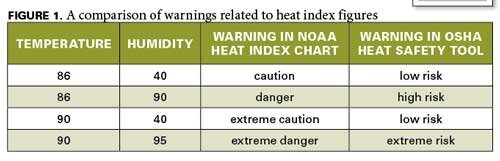
A further complication is that, in the most recent decision on heat stress (Secretary of Labor vs. A. H. Sturgill Roofing, Inc., OSHRC Docket No. 13-0224, February 23, 2015), the administrative law judge states that “it is not reasonable for [an employer] to rely solely on the generic NWS heat index to determine if a heat hazard exists at its worksite.” In light of this judge’s language, employers need to make some significant judgments during the work day if their employees are working in a high-heat environment. Obviously, in the post-frame industry crews will seldom be working close to a National Weather Service reporting site. You will need both temperature and humidity to calculate the heat index where you are, and you should consider using two sources of information to make this determination. One can be the NWS numbers, and the other can be either from the OSHA Heat Safety Tool on your smart phone or from another source of information on temperature and humidity close to your work site.
Nonetheless, although the warnings vary, the key message remains clear: when these levels are reached, you need to pay attention to the heat index and your employees’ safety and perform as a reasonable employer. NIOSH and Judge Augustine suggest five steps for addressing the problem: (1) acclimatization, (2) a work-rest regimen, (3) hydration, (4) provision of cooling-off areas and (5) training.
Acclimatization. Acclimatization involves a combination of increasingly longer periods of exposure to work in the high-heat-index environment and extended rest periods. In this process employees who are new to the high-heat-index environment can get used to the environment and the work practices you have established. Acclimatization should be employed for all new employees and any temporary employees (especially when you are unable to identify where they worked immediately before coming to your company) and also for anyone in your regular workforce who has been away from the high-heat environment for an extended period. The length of this period may vary, but any employee who has never been exposed to a high-heat-index environment or has been away from such an environment for more than 14 days will most likely need to be acclimated. It is wise to submit the proposed acclimatization plan to your company physician to be sure that he or she feels it is sufficient to protect an otherwise healthy employee from the effects of a high-heat-index environment.
Work-Rest Regimen. A work-rest regimen consists of work periods coupled with rest periods. When the workers are not working in a heat-index warning situation, a normal schedule—for example, working an 8- or 10-hour day with morning and afternoon breaks and a longer break for lunch—may be followed. But when heat-index warning levels are reached, you need to consider modifying the number and length of the rest breaks provided for your employees. As with acclimatization, you should have your company physician review your work-rest schedule to ensure that it is safe for varying heat indexes. One work-rest regimen may be fine for a heat index in the caution range, while another may be required if the heat index rises to the danger or extreme-danger range. The company physician may also identify a heat-index level at which your employees should not be working at all. Having a medical professional sign off on this part of your heat-illness prevention program will help your program pass muster with OSHA in the case of an enforcement inspection. Although the health of your employees should always be your primary concern, you also need to ensure that you are in compliance with OSHA regulations.
Hydration. You must ensure that your employees are properly hydrated. NIOSH suggests that you provide cool water and “encourage” your employees to drink five to seven ounces of water every 15–20 minutes. The OSHA Heat Safety Tool recommends that employees drink four cups of water an hour (even if they are not thirsty) when conditions are in the moderate-risk range or higher. This is another area in which the NIOSH criteria and the OSHA Heat Safety Tool differ. In any case, this is another compliance measure that should be reviewed by your company physician. The purpose of this program is to protect your employees, and your goal is to protect them from dehydration. Dehydration can be insidious in its onset. Many people do not realize that they are becoming dehydrated until they are in serious danger of heat stroke. If your company physician reviews and signs off on your proposed hydration program (which may vary depending on the heat index), you will be in the best position both to prove compliance and to protect your workforce.
Provision of a cooling-off area. You are required to provide an area where employees can cool off from the effects of a high-heat-index environment. These areas should be in close proximity to the job site, ideally within a five-minute walk. Also, if an employee is showing signs of heat stress and requires a visit to the cooling-off area, he or she should be escorted by another employee.
Training. All employees should receive training on the elements of your heat-stress program. In addition, they should be trained to recognize the health effects of a high-heat-index environment. This training should include, but is not limited to, ways to recognize in themselves and others the symptoms of the different types of heat illness and the first aid treatment for each type of heat illness.
On July 19, 2012, OSHA issued a directive to all its regional offices to expedite inspections concerning heat-related illness and to issue citations. OSHA’s announced goal was to reduce the number of heat-related illnesses and deaths occurring on job sites. In connection with this purpose the directive states that the compliance officer can conclude that the employer recognizes the heat-related hazard if
- a heat advisory is in place because the heat index is above the danger zone
- employees have complained about the heat
- employees are exhibiting signs and symptoms of heat exposure
- the employer has acknowledged the heat issue by providing some, but not all, of the necessary remediation
- the employer’s industry has issued guidance.
The directive also indicates that feasible and useful methods are available to correct the hazard, including these:
- Provide immediate access to water, rest and shade.
- Establish an acclimatization program.
- Implement a work-rest regimen.
- Provide a climate-controlled cooling-off area.
The directive continued by providing a list of questions for the compliance officer to ask you during an inspection, including these:
- Are any heat-related incidents reported on the OSHA 300 log?
- Is the heat-stress potential regularly evaluated or monitored, and how is this done?
- Do you have a heat-stress prevention program
- Do you have an acclimatization program
- Is drinking water available
- Do you require your workers to drink water
- Do you have a work-rest regimen in place
- Is shade or a climate-controlled area available for breaks?
- What are your emergency procedures for employees who exhibit symptoms of heat-related illness?
- Have your employees been trained in heat-related illnesses?
- Do your employees know the signs and symptoms of heat-related illness, proper precautions to take, the importance of drinking water frequently, the importance of acclimatization and the steps to take if someone exhibits symptoms of heat-related illness?
- Is your “competent person” capable of dealing with heat-related emergencies?
The preceding list, though not exhaustive, covers most of the concerns of safety and health compliance officers.
In conclusion, you need, at the very least, a written heat-stress program. This program should cover the critical points your employees should understand, but it should also show your recognition that the implementation of your heat-stress program is your responsibility. Compliance with heat-illness prevention steps lies with you and is not a responsibility you can transfer to your employees. Finally, of great significance, be sure you have in place the five critical components of a compliant heat-illness-prevention program: acclimatization, a work-rest regimen, hydration, a cooling-off area and training.
Gary Auman of Dunlevey Mahan and Furry is legal counsel for the National Frame Building Association.