



– By Sharon Thatcher –
When Tri-M Construction got its first opportunity to general contract a project in a high-end air community near Benton, Kan., it did so in a big way. What resulted was the largest project thus far in Stearman Estates: a 7,577 square foot home with attached hangar/garage/woodworking shop/pool area measuring another 8,305 square feet.
To accomplish the hangar and supporting areas, two metal buildings were married into one and concealed with architectural elements.
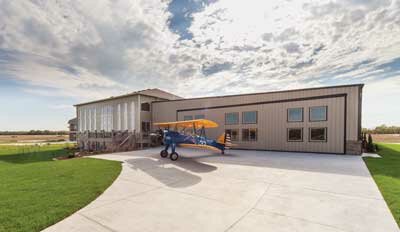
The successful marriage of metal and structural insulated panels was the perfect answer for a Navion airplane owner who lives in a high-end air community in Kansas. The plane rest in front of the one-piece 60 x 16 foot hangar door from Powerlift Hydraulic Doors.
Miles Millspaugh, who co-owns Tri-M with his father, explained that the owner of the property had initially consulted another business about the project but came to the Millspaughs looking for a second opinion.
“He was actually working with someone else on an architectural drawing but they were just not understanding what he wanted,” he said.
In the case of Tri-M Construction, the contractor-client relationship was a perfect fit for both. Millspaugh does his own blueprint and design work, so he was able to work closely with the client on the design.
“We spent the next several months getting exactly what they wanted, going through several versions,” he said.
The owner had an idea of what he wanted but it changed over time as circumstances dictated.
“Originally he wanted a detached hangar,” Millspaugh said. “Then we found out we had to attach the hangar to the house because of the size. Under the zoning requirements you couldn’t have anything detached if it was more than 4,000 square feet.”
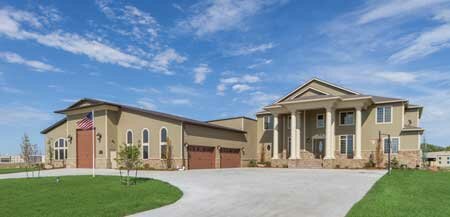
Located in an air community, height was also a major factor.
“We had to be really conscious of height because it is an airfield. There is a particular formula for how far you are off the runway to what your exact height can be,” said Millspaugh.
For building the hangar, Millspaugh relied on Behlen dealer Greg Soelter of GBS Enterprises LLC, Bel Aire, Kan.
Technically, two Behlen buildings were used, but they were designed as one unit. Soelter explained: “Behlen designed it as one building but with different frame lines. The backside (an 80 x 60 space), where we have the hangar, we have a single slope. Then when you get to the front of the house (an 80 x 40 space) that single slope turns into the gabled roof with a 4:12 pitch so water drains away from the house.”
The single slope covers the hangar area. The gabled roof covers the 4-car garage, RV storage, shop area, and underneath that area, a concrete swimming pool.
The hangar features PowerLift hydraulic doors that measure 60 feet wide x 16 feet tall. It is a one-piece unit. “That’s the nice thing about it and what our customers like,” Soelter said. “It’s a very simple door and it’s low maintenance because of its simplicity.”
Doors of this size were an interesting first-time challenge for both Millspaugh and Soelter, but Soelter was so impressed by the product that he expanded his business enterprises by becoming part owner of a franchise called S&S PowerLift Hydraulic Doors.
“The 60-foot door scared me half to death,” Soelter admitted. “We were so new [to doors of this size] we didn’t even have a trailer to haul it on, we had to hire a trucking company to haul it the 40 miles from point A to point B. Now I look back on it and we’re installing 70-foot doors and bigger and we’re putting them on our own trailers and hauling them all over Kansas.”
One recently traveled to Texas.
The house itself is made with structural insulated panels by Enercept, also supplied by Soelter who is an Enercept dealer. It was constructed by Tri-M.
Initially the owner had inquired about insulated concrete forms. “It isn’t often I get people wanting to do an ICF home, so when I realize someone is interested in spending that type of money, then I go into this whole SIPS conversation,” Millspaugh said. “It’s a very good alternative for the long-term.”
To tie the house and adjoining hangar together, stone wainscot was used around the entire structure. The front half of the hangar portion has horizontal siding to match the house along with large crown molding to match.
The structure features geothermal heat and air, utilizing four units and eight breaker boxes to get the job done.